Your Roth IRA Is Not Fully Locked Up: Three Buckets Business Owners Need to Know
A Roth IRA is not automatically untouchable until age 59½. But direct contributions, conversion dollars, and investment earnings follow different tax rules, so a cash-flow decision should start with identifying which dollars you actually have.
K&S Associates
Business owners often hear two conflicting messages: “Never touch retirement money,” and “You can pull money from a Roth IRA whenever you want.” Each is only partly true. When a refrigerator fails at a restaurant, a slow season hits a laundromat, or a contractor needs payroll cash before an invoice is paid, that distinction becomes a real operating decision.
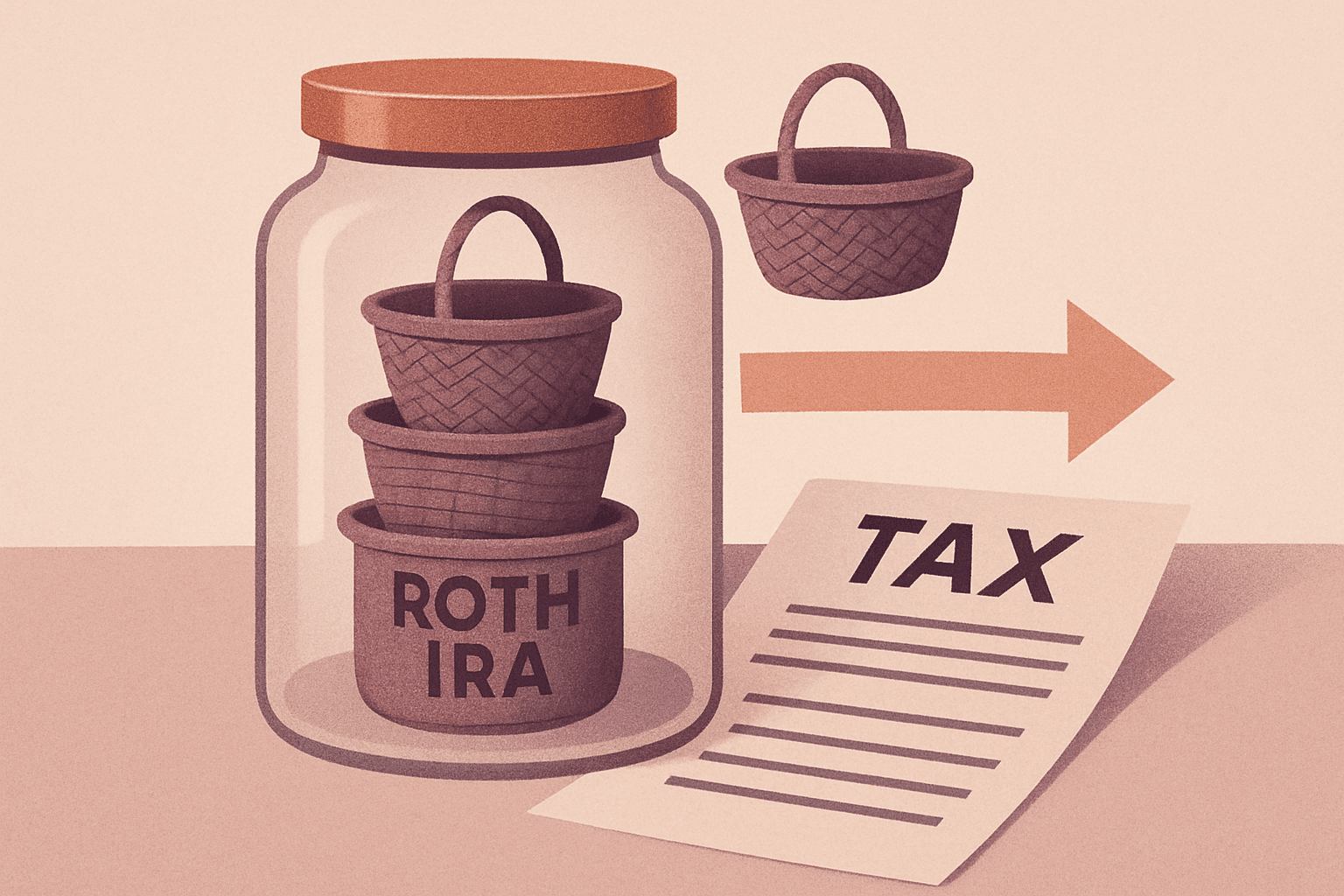
Not every dollar in a Roth IRA has the same tax treatment. Regular contributions you made directly, amounts converted from another retirement account, and investment earnings have different withdrawal rules. Looking only at the account balance and assuming it is all tax-free can create an unpleasant surprise when the tax return is prepared.
Start with the three buckets inside a Roth IRA
The first bucket is your regular Roth IRA contributions: money contributed directly under the annual income and contribution rules. In general, these contribution dollars can be withdrawn at any age without income tax or the 10% early-distribution additional tax. If you have made $24,000 of direct contributions over several years and the account is now worth $31,000, the first $24,000 is generally contribution basis.
The second bucket is conversion money. This may come from a traditional IRA, SEP IRA, SIMPLE IRA, or an employer retirement plan that was moved into a Roth IRA. The taxable part of a conversion is generally reported as income in the year of conversion. That can make people think the money is immediately free to withdraw. But if you are under age 59½, a separate five-year rule may affect whether converted dollars trigger the 10% additional tax.
The third bucket is earnings: dividends, interest, and investment growth inside the account. Earnings can grow in the account, but a withdrawal may be taxable and may carry the 10% additional tax if timing and qualification requirements are not met.
The IRS ordering rules—not your preference—control the withdrawal
Roth IRA withdrawals generally follow a prescribed order. Regular contributions across all of your Roth IRAs are considered to come out first. Conversion and rollover amounts come next, followed by earnings. Even if you withdraw from one particular account, the analysis generally considers your Roth IRAs as a group.
Before asking whether you can withdraw Roth money, identify whether the dollars are contributions, conversions, or earnings.
Suppose Maya has $18,000 of total direct contributions across two Roth IRAs, converted $12,000 from a traditional IRA in 2024, and now has combined Roth balances of $37,000. If she withdraws $8,000, it would generally come first from her $18,000 of regular contributions. If she withdraws $20,000, the $2,000 above her contribution amount moves into the next bucket and requires a conversion-rule review.
This is why a year-end account statement is not enough. It may show the balance, but not a clean record of your cumulative contributions and conversions. Keep the tax returns that reported contributions and conversions, along with Forms 5498, 8606, and conversion-related Forms 1099-R. Without records, even a tax preparer may have to work from incomplete information.
There is more than one five-year rule
The five-year rules are among the most misunderstood Roth IRA issues. First, there is a five-year period for qualified withdrawals of earnings. It generally begins on January 1 of the tax year for your first Roth IRA contribution or conversion. Completing that period alone is not enough to make earnings tax-free. A qualifying event is generally also required, such as reaching age 59½, death, disability, or a qualifying first-home purchase. The first-home exception has a $10,000 lifetime limit and does not automatically apply in every situation.
Second, there is a five-year rule for conversion dollars. If you are under age 59½ and withdraw converted amounts, each conversion year can have its own five-year period for purposes of the 10% additional tax. This is separate from the income tax paid when the conversion occurred. A person who converted funds in 2022, 2024, and 2026 may be tracking three different timelines.
Tax-law exceptions exist, but “there may be an exception” is not a sound operating plan. Disability, death, certain medical costs, and education expenses can involve specific rules and facts. A business loss or a working-capital shortage is not, by itself, a general Roth IRA withdrawal exception.
Do not rush into a Roth conversion during a strong income year
A Roth conversion moves pre-tax retirement money into a Roth account and generally adds the taxable converted amount to income for that year. It can be useful if future tax rates are likely to be higher and you have cash outside the retirement account to pay the tax. But converting a large amount in a year with strong business profits, a business-sale gain, or high spouse income can push more income into higher tax brackets.
For example, imagine a married couple with $90,000 of taxable income before a planned $80,000 conversion. That $80,000 does not necessarily face one uniform tax rate. Filing status, other income, deductions, capital gains, and state income tax can all change the result. Paying the conversion tax by taking more money from an IRA can create another issue, especially for someone under age 59½.
- Add up business income, spouse income, bonuses, and capital gains before modeling the conversion.
- Compare a partial conversion over several years with conversion in a lower-income year.
- Confirm whether taxes can be paid with cash outside the retirement account.
- Convert a large amount at once because someone said Roth accounts are always better.
- Use IRA funds to pay the conversion tax without checking the consequences.
- Assume a future move will automatically make state-tax planning work in your favor.
Use this decision process before tapping a Roth IRA
The fact that a contribution withdrawal may be allowed does not mean it is the best business decision. Replacing withdrawn dollars is not always simple. Annual contribution limits and income rules apply, so taking out $15,000 that you contributed in prior years does not mean you can simply put $15,000 back next month as a regular contribution. A 60-day rollover may be available in limited circumstances, but it has restrictions and is not a casual working-capital tool.
- Write down the exact cash need and timing. Separate rent, payroll, inventory, and equipment repair instead of calling it all “working capital.”
- Compare bank cash, business credit lines, equipment financing, tax-payment dates, and emergency reserves. Review repayment ability and personal-guarantee exposure, not just the interest rate.
- Verify cumulative direct contributions, conversion amounts by year, and the year of your first Roth IRA using tax records.
- Calculate the tax result before and after a withdrawal, and ask the custodian what distribution forms will be issued.
- If you withdraw funds, retain the amount, date, purpose, and supporting records for your next tax return review.
A retirement account should not be the first account used to cover a short-term business gap; it protects long-term options. But it also does not need to be treated as money you can never access. Once you separate the character of the dollars, this year’s income, and the business’s future cash needs, the difference between an available withdrawal and a wise withdrawal becomes much clearer. Before completing a conversion or distribution, review your recent tax return and Roth transaction history with a tax professional who can evaluate your specific facts.
Next step
Does this issue apply to your U.S. entity?
If the situation sounds familiar, start with where the books, close, payroll, and HQ reporting stand today.
Request a consultation